
Tell your clients what the business is worth.
Then show them how to make it worth more.
A quarterly report built straight out of the QuickBooks file you already keep. It values the business, then hands the owner a ranked list of moves that raise that value, each one costed. Your logo, your name, your price.
You set the price your client pays and keep the difference. No build, no software to learn, no extra hours. Call us and we will walk the numbers on your own client list.
- Your brand on every page
- Built from the file you already keep
- Nothing for your team to run
What it is worth today
$1,420,000
4.7x adjusted earnings · read from your QuickBooks on 30 September
Value we can add in 18 months
+22%
$312,000 of new value
Cash sitting in the business
$9,500
a month, freed
Local pricing gap
11%
under the three nearest rivals
Owner dependence
High
the biggest single discount
Top move this quarter
Raise the standard service call from $129 to $145. Every shop within nine kilometres is already above you. Worth $38,000 a year at today's volume, and it lands in the multiple.
Illustrative example ~ every report is built from that client's own ledger and produces its own figures.
Value the business. Then lift the value.
Knowing the number is the start, not the point. The point is that the number goes up, quarter after quarter, because the owner is working the list you hand them. More profit while they own it, a higher price when they sell it, and the business is sale-ready the whole way through.
Value it
A defensible number off their own ledger, with the multiple and the add-backs shown. Every quarter, so the trend is visible.
$1,420,000
worth today
Lift it
Where the value is leaking and what closes the gap: pricing, unserved demand, margin, customer concentration, owner dependence. Each move carries the dollars it adds.
$312,000
of new value, a 22% lift
Stay exit ready
The same work that raises the value is the work a buyer or a lender checks. Done quarterly, the business is never more than a quarter from sellable.
Scored
risk and readiness, every quarter
The books are no longer the product.
Bank feeds categorise themselves. Receipts read themselves. Every year a client is one more click away from asking why the monthly fee looks the way it does. Competing on accuracy is competing on something the software already claims to do.
The firm that sends statements
Answers the question the client already asked. Priced against the cheapest quote in town.
The firm that sends a valuation
Answers the question the client has never been able to afford to ask. Priced against what it is worth to know.
The difference
One is a cost the owner is looking to cut. The other is the reason they stay.
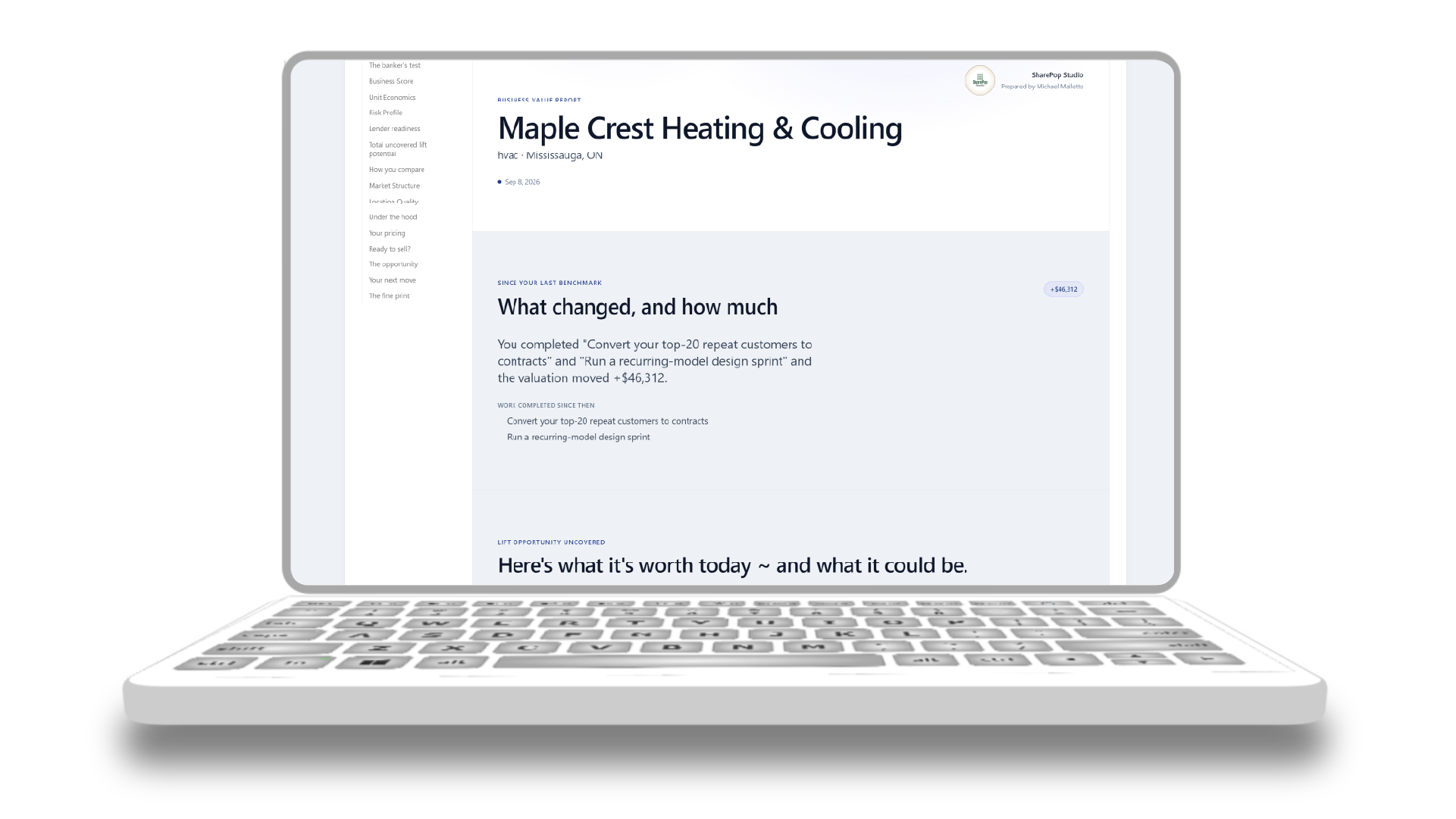
What lands in your client's inbox
One report, every quarter, under your name. It is built from their own ledger, so nothing in it can be argued with.
Defensible
What the business is worth
A valuation off the actual QuickBooks file, with the add-backs shown and the multiple explained. Not a guess, not a range wide enough to be useless.
Comparative
Where they sit in their market
How their margins, growth and pricing compare with the businesses they actually compete against, by industry and by region.
Local
The whitespace nobody else sees
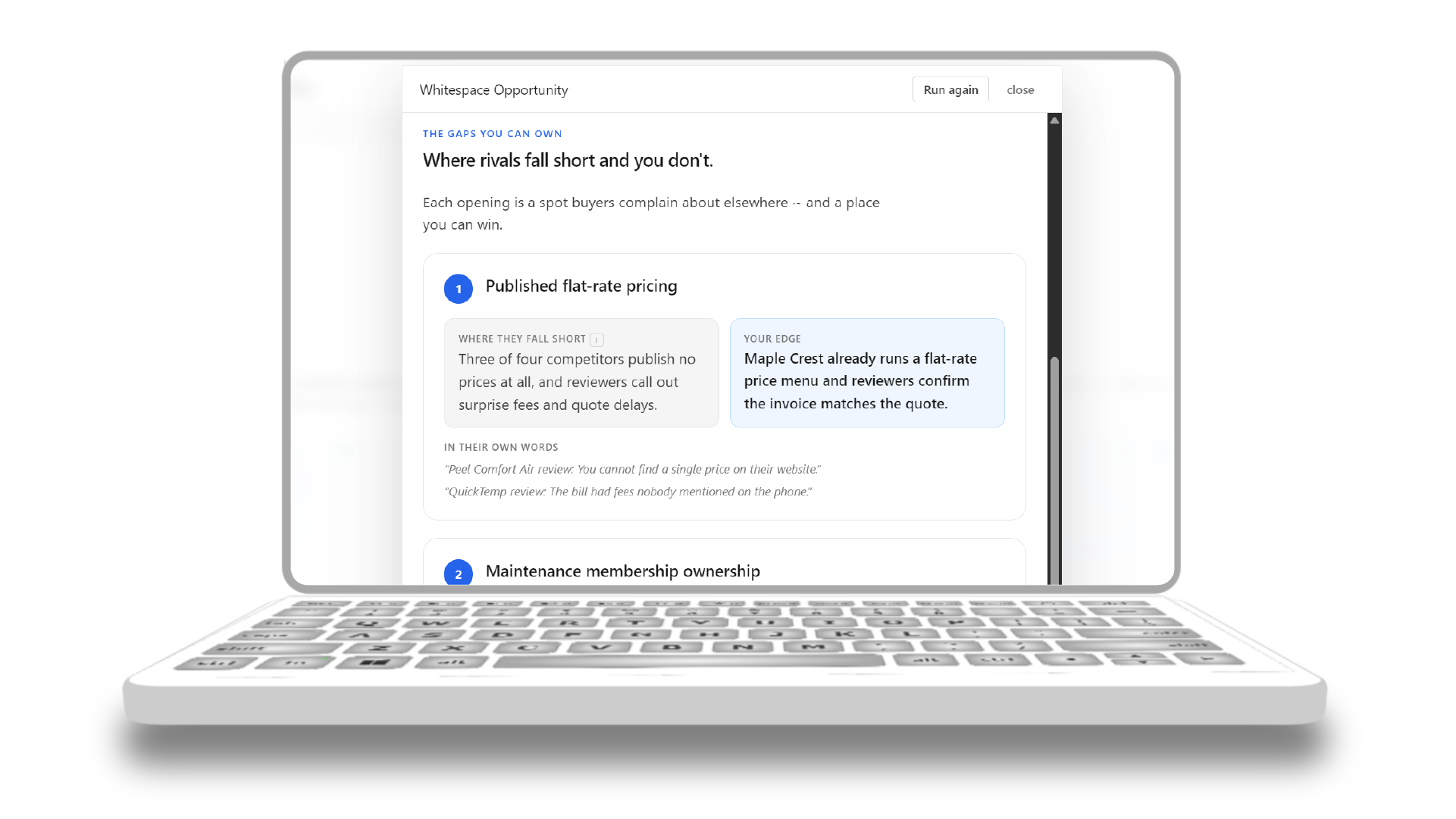
Demand in their own service area that no competitor is serving, and the price the market is already paying for it.
Actionable
What to do about it
A ranked list of moves with a dollar figure on each one, and the value each move adds. They tick them off. Next quarter shows whether it worked.
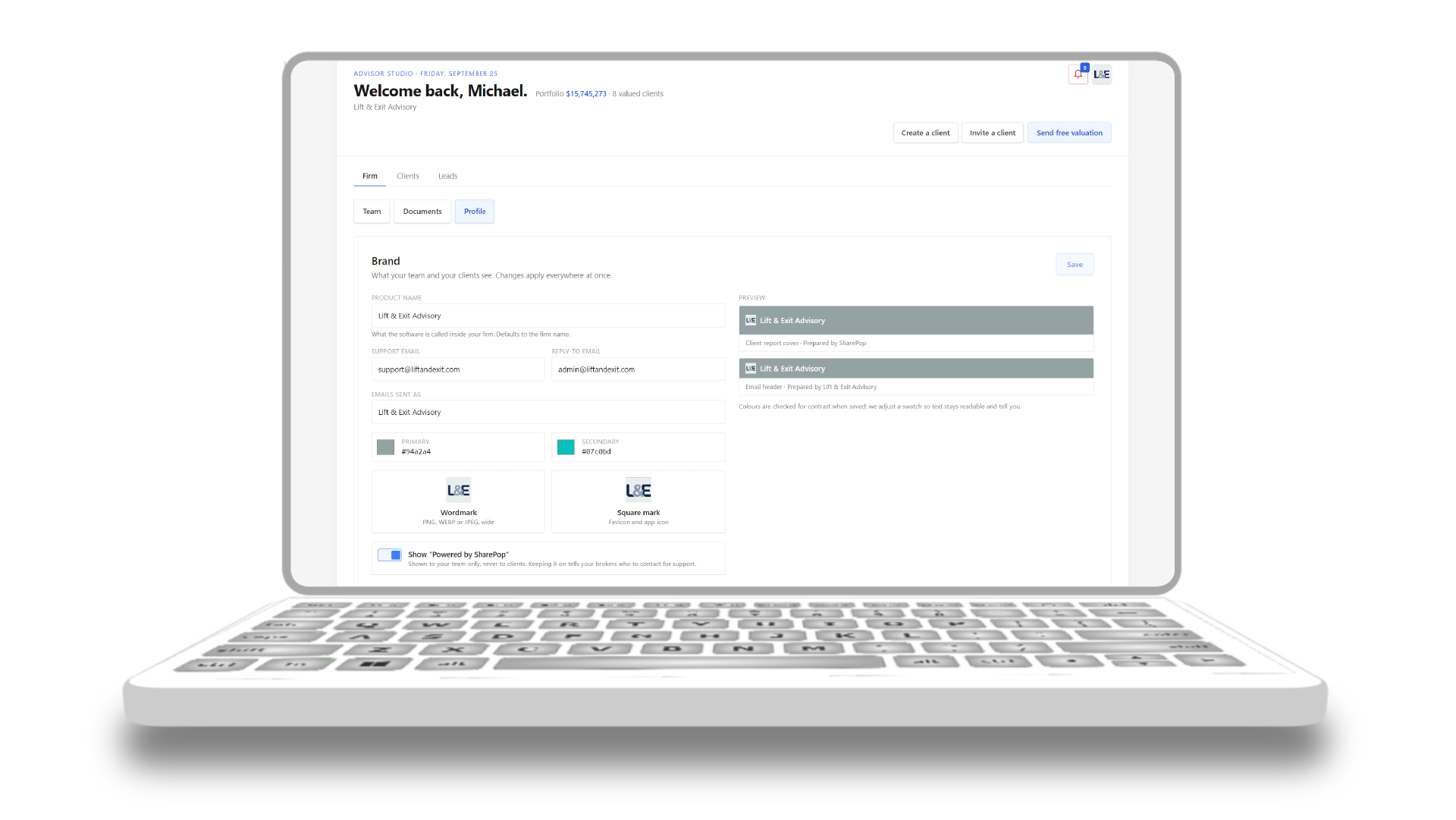
Your logo on it. Our name nowhere.
The report your client opens carries your firm name, your logo and your colours on every page. There is no SharePop badge, no powered-by line, no footer giving us away. As far as your client is concerned, their bookkeeper started doing valuations.
- Your firm name, logo and brand colours throughout
- Sent from you, on your schedule, to the list you already own
- Billed on the invoice your client already receives from you
- One wholesale invoice back to the firm, never to your client
Not national averages. Their street.
Anyone can tell a plumbing company what plumbing companies earn. The report tells this plumbing company what the four shops inside its own service radius charge, which services none of them offer, and what that gap is worth in revenue this year.
That is the part an owner reads twice, and the part they cannot get from their bank, their software, or a chatbot.
Local opportunity · Riverside Plumbing Co.
- $64,000
Emergency after hours callout
Nobody within nine kilometres advertises it. Two rivals refer it away.
- $71,000
Annual maintenance plans
One competitor sells them at $340 a year. You have 210 repeat customers.
- $38,000
Standard call rate
Yours is $129. The local band is $141 to $165.
Illustrative example ~ every scan is run against that client's own service area and produces its own findings.
Everything in the quarterly report
Two halves. The first half says what the business is worth. The second half says how to make it worth more. All of it off the same ledger, with no work from you.
Half one
What it is worth
The number, and everything that sets it.
Business Valuation
What the business is worth today, the multiple it earns, and every add-back that got it there.
Business Score
One number for how the business is performing, broken into the parts a buyer prices.
Unit Economics
What one sale, one job, one customer actually makes after everything is counted.
Lender readiness
What a lender would say today: coverage, leverage, the gap between them and a yes.
Risk Profile
Owner dependence, customer concentration, key staff, the risks that discount the price.
Half two
How to lift it
Where the value is leaking, and what closes the gap.
Price Position
Their rates against what the market nearby actually charges, service by service.
Whitespace Opportunity
Demand inside their own service area that no competitor is serving, and what it is worth.
Local Market Scan
The market they really sell into: size, growth, who is winning and who is leaving.
Market Structure
How crowded the field is, who the real rivals are, and where the pricing power sits.
Location Quality
Whether the address helps or hurts, and what the catchment supports.
Client Acquisition Cost
What it costs them to win a customer, and which channel is quietly losing money.
Marketing Strategist
A local campaign built on the gaps above, not generic advice about posting more.
Referral Builder
The cheapest growth they have, turned into something repeatable.
Growth Plan
Everything above ranked into a quarter of work, each item carrying the value it adds.
Every one of your clients sells eventually.
Most of them start thinking about it eighteen months out, which is years too late to change the number. The work that lifts a multiple ~ cutting owner dependence, tightening margins, making the revenue repeat ~ takes three to five years to show up in a price.
You are the one person already in their numbers every month. When the report lands quarterly, you are the reason they started early, and the person they call when they are ready.
What starting early is actually worth
| Starts planning | Typical sale price |
|---|---|
| Five years out | $1,960,000 |
| Three years out | $1,640,000 |
| Eighteen months out | $1,420,000 |
Illustrative, on the same business. The gap is the work, not the market.
You keep the difference. All of it.
The firm pays one wholesale rate per client, per quarter. You decide what your client pays, and the spread is yours. There are no tiers to climb, no minimum to hit, and nothing changes if you grow.
One wholesale rate
The same rate per client per quarter whatever you charge and however many clients you switch on.
You set retail
Price it where it belongs in your own fee structure. We never see what your client pays and never contact them.
One invoice, to the firm
We bill the firm once. Your client is billed by you, on the invoice they already receive from you.
Talk to a person
Call us and we will price it with you.
Tell us roughly how many clients are on your books and we will walk the wholesale rate, the retail range other firms land on, and what you would keep. No form first. Or send it in writing instead.
There is nothing for you to build
Connect once
Your clients approve the QuickBooks connection you already manage. One click each, and it never has to happen again.
We build the reports
Every quarter, automatically, under your logo and your firm name. Nothing in the report says our name.
You send one email
To a list you already own, of people who already pay you and already trust you. That is the entire job.
You bill it your way
On the invoice they already receive from you, at the price you chose. We bill you once, for the firm.
Your clients already trust you with the numbers.
This is the quarter you start telling them what the numbers are worth.